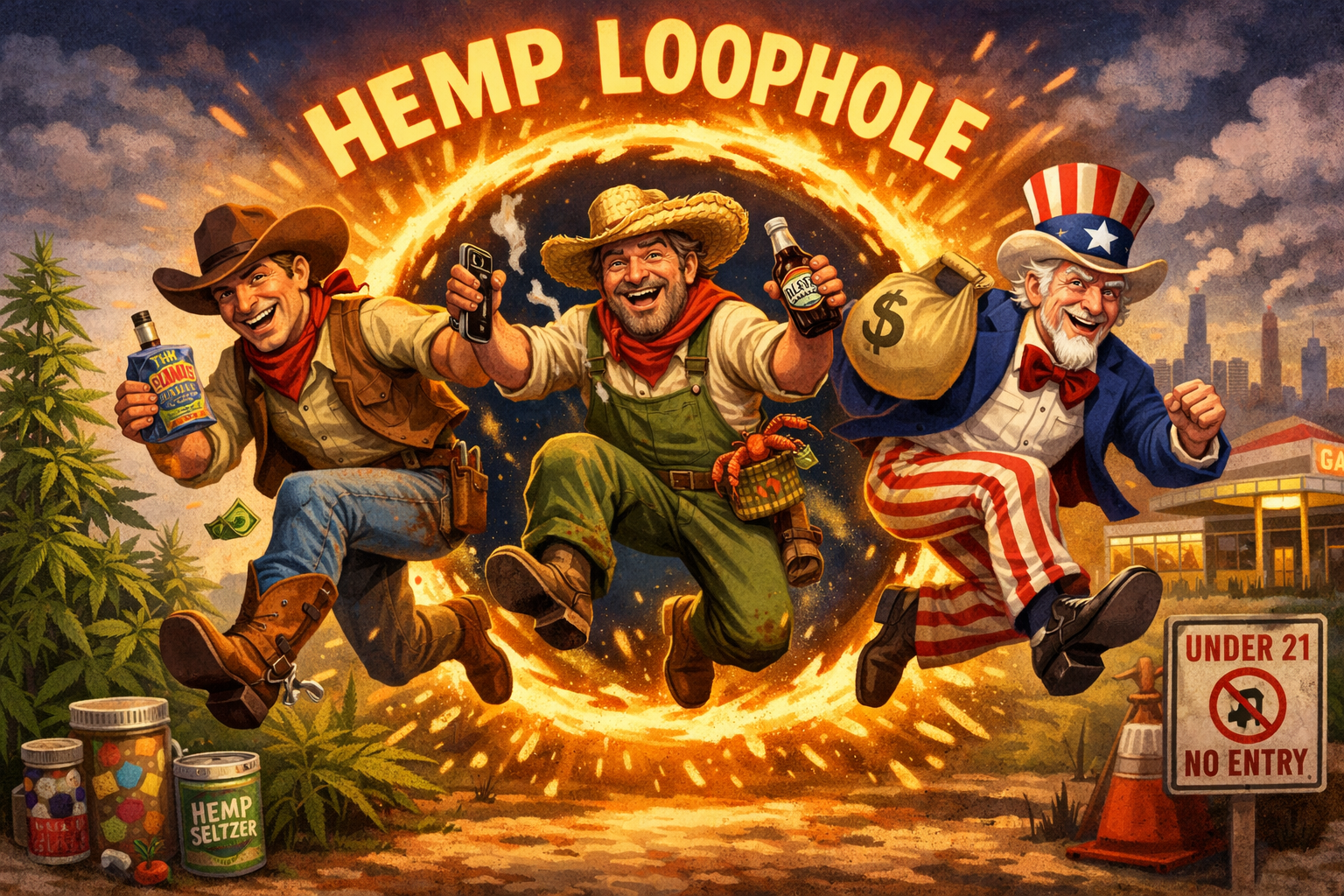
Since the 2018 Farm Bill legalized hemp nationally, the consumable hemp market — especially products derived from hemp like THC edibles, beverages, and CBD goods — has grown explosively into a multi-billion-dollar industry. What started as an agricultural experiment has, in many states, turned into a wild frontier of unregulated products, legal loopholes, lax oversight, and public health concerns. (Wikipedia)
But behind the hype and colorful packaging lie problems that many lawmakers, public health officials, and consumers are only now beginning to address.
Legal Loopholes Fueled a Wild Market
The core of the issue stems from the “hemp loophole” in the 2018 Farm Bill. That law defined hemp based solely on its delta-9 THC content (no more than 0.3%), but did not address other psychoactive compounds like delta-8 and delta-10 THC. (Wikipedia)
As a result, producers could create intoxicating products that, on paper, met the law’s definition of “hemp” — even if the effects were similar to marijuana. This created an unregulated market of intoxicating hemp-derived consumables that looked, tasted, and acted like cannabis products sold in legalized states, yet slipped through regulatory cracks. (Network for Public Health Law)
Without federal clarity, many states struggled to regulate these products, allowing them to proliferate in smoke shops, convenience stores, online, and youth-oriented venues.
Confusing and Exploitative State Markets
In states without robust regulation — like Texas — the industry grew faster than lawmakers could keep up with.
For example:
- • Hemp-derived consumable products with psychoactive effects have flooded the market under the “hemp” label, even though they resemble marijuana products more than traditional CBD goods. (Kut)
-
- • Emergency rules banning sales to people under 21 were passed only after critics sounded alarms about minors’ access to these products. (News From The States)
-
- • Proposed regulatory fee hikes — with licensing and registration costs jumping by thousands of percent — have sparked debate that regulation may be punitive or financially exclusionary rather than consumer-safety grounded. (FOX 7 Austin)
-
This broad, loosely regulated environment created space for marketers to make dubious claims, falsify lab results, and sell products with uncertain potency or safety profiles — often with minimal consequences.
Public Health and Safety Concerns
Federal agencies and public health advocates have repeatedly warned about the dangers of an unregulated hemp consumables market:
The FDA has issued warning letters to companies selling delta-8 THC products with illegal claims and without proper safety evaluation. (U.S. Food and Drug Administration)
Research has linked significant adverse events from hemp-derived THC products, sometimes at higher rates than marijuana itself, pointing to a lack of standardized testing, dosing, and quality controls. (ProPublica)
States that have moved to constrain intoxicating hemp (e.g., setting strict milligram limits or banning entire product categories) have faced legal and political pushback, highlighting how ambiguities in the law can shield problematic products. (ASTHO)
Consumers are often left to interpret colorful labels and marketing claims with little scientific backing. This “consumer-beware” marketplace has eroded trust and put vulnerable populations — especially youth — at risk.
Political and Economic Forces at Play
The debate over hemp regulation is not just about safety — it’s intrinsically political.
Federal efforts (such as changes to the Farm Bill and appropriations language) are closing loopholes, redefining hemp to include total THC limits, and potentially banning many intoxicating products entirely. (Wikipedia) Industry groups warn that sweeping restrictions could destroy a multi-billion-dollar market and cost hundreds of thousands of jobs. (capitol-beat.org) Many states find themselves in regulatory limbo — trying to balance public safety with economic interests, often while the industry fights to keep products legal in court.
This collision of lawmakers, corporate interests, regulators, and consumers has sometimes favored market growth and corporate profits over thoughtful regulation.
What This Means for Consumers — and States
The takeaway is stark:
• Consumers are navigating a largely unregulated system, where product safety and labeling accuracy are inconsistent.
• States are scrambling to regulate products that defy easy categorization under existing cannabis or alcohol laws.
• Public health officials are raising alarms, but regulation often lags behind commerce.
Without decisive action — either through federal classification, stringent safety testing requirements, or clear state licensing frameworks — the market risks further corruption, misinformation, and harm.
Actionable consumer guidance
Practical steps to reduce risk in a loophole-heavy hemp market—especially in states where rules are changing quickly:
1) Treat “hemp” labels as marketing, not a safety guarantee “Farm Bill compliant” does not automatically mean it’s safe, accurately dosed, or legal in your state next month.
2) Verify the COA, but don’t stop there Look for a recent Certificate of Analysis (COA) that matches:
-
- the exact product name
- the batch/lot number
- the serving size
- Red flags:
- COA has no lot number
- COA is older than ~12 months
- COA shows only “cannabinoids” but not pesticides, heavy metals, residual solvents, and microbials
- COA is a blurry screenshot or a dead QR code
-
3) Watch for “dose stacking” tricks A common loophole behavior is packing multiple servings into one edible/drink so total intoxicating dose is high even if “per serving” looks small. Prefer products with:
-
- clearly defined serving sizes
- tamper-evident, child-resistant packaging
- plain-language dosing instructions
-
4) Avoid kid-appealing products and sketchy retail settings If it looks like candy marketed to children, skip it. Be cautious with products sold in gas stations, impulse aisles, or where staff can’t answer basic questions about testing and dosing (Louisiana specifically targeted convenience-style sales as a policy problem).
5) Be extra careful with vapes and “converted cannabinoids” Many controversial intoxicating hemp products involve chemically converted cannabinoids (often discussed in policy debates). If you can’t tell what’s in it beyond buzzwords, don’t inhale it.
6) Know your state’s “moving target” rules before you buy
- Texas: age restrictions and enforcement have tightened; rules have changed via emergency actions.
- Arkansas: enforcement has included seizures and retailer sweeps after courts allowed the ban to be enforced.
- Louisiana: product forms, retail channels, and labeling/testing rules have tightened since 2024–2025.
- Mississippi: legislative efforts and enforcement messaging have been in flux—meaning “what’s on shelves” may not equal “low-risk.”
-
7) Health and safety: start low, don’t mix, don’t drive
If you choose to use intoxicating hemp products: start with the lowest dose, avoid mixing with alcohol or sedatives, don’t drive or operate machinery, keep away from kids/pets
8) If you suspect a bad product, report it. Save packaging + receipt, take photos, and report to your state health/regulatory agency. (Texas DSHS provides a consumable hemp program hub and contact pathways.)
Toward a More Responsible Hemp Market
Addressing these challenges will take concerted action:
- • States need uniform testing, labeling, and marketing standards, similar to what is required for adult-use cannabis (medical marijuana).
-
- • Federal policymakers must clarify legal definitions so that intoxicating hemp products cannot exploit regulatory loopholes.
-
- • Consumers deserve transparent information about product contents and risks, with protections that prioritize safety over sales.
-
Only then can the potential benefits of hemp-derived products be realized without the corruption and confusion currently plaguing the market.
Summary
While intoxicating hemp definitely has its grey areas, treating your condition with medical marijuana through The Healing Clinics provides a safer, physician-led journey. Contact The Healing Clinics to get started.