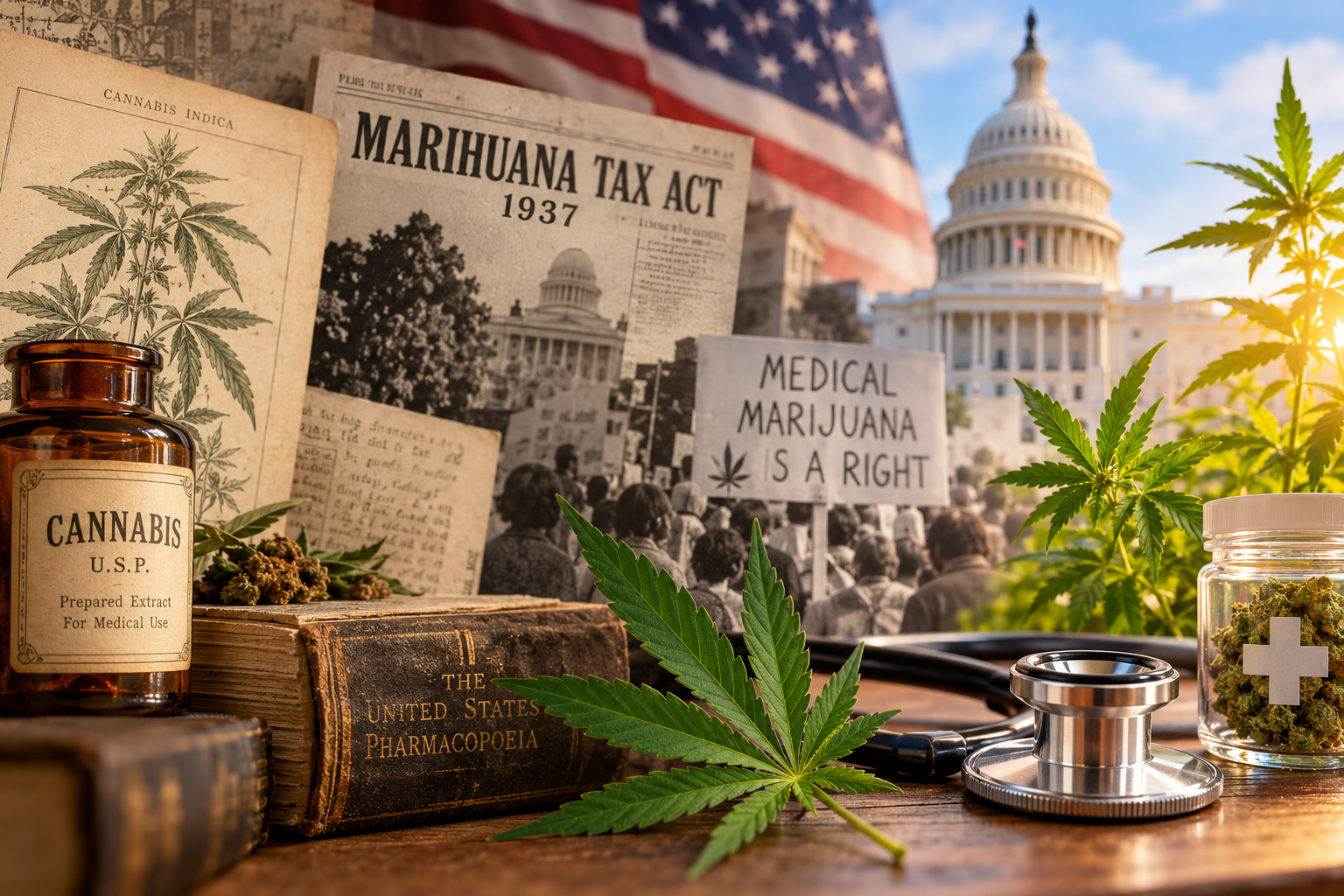
Do you ever stop for a moment and think, “How did we get here?” How did we get back to wading through rivers of laws and regulations to prove AGAIN that marijuana is medicine? Marijuana has been used for medicinal purposes since around 2737 BCE in ancient China, the first recorded use in China, when the mythical Emperor Shen Neng prescribed cannabis tea to treat gout, rheumatism, and malaria. And now, all these years later, the debate over marijuana in the United States can sometimes make cannabis seem like a relatively new medical treatment. Maybe finding out more about the history of marijuana in the United States can shed some light on the long journey this medicinal plant has taken.
Cannabis appeared in the United States Pharmacopeia in the mid-19th century. Physicians and pharmacists used cannabis preparations for conditions including pain, insomnia, and convulsions. Medical references described cannabis extracts and tinctures and provided instructions for their preparation.
Over the next century, however, cannabis went through one of the most dramatic changes in the status of almost any substance used in American medicine. It moved from pharmacy shelves to prohibition, then slowly returned to medical use through patient advocacy, scientific research, and state-level legalization.
Understanding that history helps explain why marijuana laws in the United States remain so complicated today.
Cannabis in Medicine Before the 20th Century
Cannabis has been cultivated by humans for thousands of years. Its medicinal use predates the United States by centuries.
Cannabis entered Western medicine more prominently during the 1800s. Irish physician William Brooke O’Shaughnessy, who worked in India, published observations on cannabis preparations for conditions such as convulsions and tetanus during the 19th century. Cannabis was subsequently incorporated into Western medical practice.
By 1851, cannabis appeared in the third edition of the Pharmacopoeia of the United States. Later editions described preparations that physicians used as analgesics, sedatives, and anticonvulsants.
In other words, cannabis was not originally introduced to American society primarily as a recreational drug. It had an established role in the country’s early pharmaceutical system.
How Marijuana Went From Medicine to Prohibition
Attitudes toward cannabis changed considerably during the early 20th century.
States began restricting marijuana, while public discussion increasingly connected the drug with crime, intoxication, and particular immigrant and minority communities. Scholars examining the period have documented the role that racialized political and cultural narratives played alongside concerns about drug use and public safety in the movement toward prohibition.
The federal government dramatically increased restrictions with the passage of the Marihuana Tax Act of 1937.
The law imposed registration requirements and taxes on marijuana. Medicinal cannabis was taxed at a much lower rate than non-medical marijuana, but the administrative requirements nevertheless made medical use increasingly difficult.
The American Medical Association opposed aspects of the legislation, arguing at the time that the scientific evidence concerning marijuana’s harms was inadequate and that new restrictions could interfere with research into legitimate medical uses.
In 1942, cannabis was removed from the United States Pharmacopeia, marking the end of its earlier era as a routinely recognized American pharmaceutical medicine.
The War on Drugs and the Controlled Substances Act
Federal marijuana policy became even more restrictive during the middle of the 20th century.
The Boggs Act of 1951 increased penalties and grouped cannabis with narcotic drugs. Additional drug laws followed during the 1950s.
Then came a major turning point.
Congress passed the Controlled Substances Act in 1970, placing marijuana in Schedule I, the most restrictive category under the federal scheduling system. The Drug Enforcement Agency (DEA) was founded on July 1, 1973, under then-President Richard M. Nixon. That classification profoundly influenced American cannabis policy for decades.
It also created an unusual contradiction: patients and researchers continued reporting potential medical benefits even while marijuana’s federal classification treated it as having no currently accepted medical use.
Patients Help Bring Medical Marijuana Back Into the Conversation
During the 1970s, 1980s and 1990s, patients increasingly became part of the marijuana policy debate.
Some people with cancer, glaucoma, HIV/AIDS, and other serious illnesses reported that cannabis helped with symptoms such as:
- • Pain
- • Nausea and vomiting
- • Loss of appetite
- • Wasting
- • Muscle spasms
- • Sleep difficulties
The federal government even operated a Compassionate Use Investigational New Drug program that allowed marijuana to be supplied to certain individual patients beginning in the late 1970s. The program eventually closed to new applicants.
Patient advocacy became particularly visible during the AIDS epidemic. Compassionate use started with the provision of investigational medicine to certain patients in the late 1970s, and a formal program was established in 1987 in response to HIV/AIDS patients requesting access to drugs in development.
For some patients experiencing severe nausea, wasting, and appetite loss, cannabis was viewed not as a counterculture symbol but as a way of managing debilitating symptoms.
That distinction helped reshape the national conversation.
The question increasingly became: Should seriously ill patients be arrested for using cannabis if they and their doctors believe it provides medical relief?
When Did Medical Marijuana Become Legal (… again)?
The modern American medical marijuana movement reached a historic milestone in 1996.
California voters approved Proposition 215, the Compassionate Use Act, making California the first state to provide statewide legal protection for the medical use of cannabis when recommended by a physician.
The measure specifically referenced patients with conditions including cancer, AIDS, chronic pain, spasticity, glaucoma, arthritis, and migraine, while also allowing physician-recommended use for other illnesses for which cannabis provided relief.
California’s decision proved enormously influential. Other states began adopting medical marijuana programs, creating the state-by-state system that continues to characterize American cannabis policy.
Medical marijuana therefore did not suddenly appear in 1996 or even in 2018 when Louisiana finally launched its medical marijuana program. Instead, 1996 marked the beginning of the modern state-regulated medical cannabis era, following nearly a century in which cannabis had moved from accepted medicine to increasingly strict prohibition.
Public Opinion Has Played a Major Role in Marijuana Laws
Few issues demonstrate the relationship between culture, public opinion, and law as clearly as marijuana.
When Gallup first asked Americans about marijuana legalization in 1969, only 12% favored legalization. Public attitudes changed dramatically over the following decades. Support increased to roughly one-quarter of Americans during parts of the 1970s, fell or stagnated during the anti-drug campaigns of the 1980s and early 1990s, and then began climbing substantially during the 2000s. By 2023, Gallup measured support as high as 70%. In its 2025 polling, 64% of U.S. adults said marijuana use should be legal.
This shift illustrates an important point: Marijuana laws do not develop in a cultural vacuum. Elected officials, voters, physicians, patient advocates, law-enforcement organizations, researchers, businesses, and community groups all influence cannabis policy.
As public attitudes changed, marijuana policies changed with them.
How American Culture Changed the Perception of Marijuana
During different periods of American history, marijuana has represented very different things.
In the early 1900s, political campaigns often portrayed marijuana as a dangerous intoxicant associated with crime and social disorder.
During the 1960s and 1970s, marijuana became strongly associated with youth culture, music, political protest and the counterculture.
During the 1980s, the broader War on Drugs and anti-drug campaigns again reinforced negative attitudes toward marijuana and other controlled substances. Gallup’s historical polling shows legalization support retreating after increases during the 1970s.
The AIDS crisis and medical marijuana movement helped create another cultural shift during the 1980s and 1990s. Cannabis increasingly became associated not only with recreational use but also with seriously ill patients seeking symptom relief.
By the 2000s and 2010s, medical cannabis programs became increasingly common, and millions of Americans lived in states where marijuana was legally available for medical purposes.
As marijuana became more visible in mainstream American life, public perceptions continued to change.
Culture influenced law — and law influenced culture.
Legal medical programs made marijuana use more visible and normalized conversations between patients and healthcare professionals. Greater familiarity, in turn, contributed to changes in public attitudes.
Why Marijuana Can Be Important in Medical Treatment
Medical cannabis should not be presented as a cure-all. Evidence varies significantly depending on the medical condition, cannabis product, dose, and method of administration.
Nevertheless, cannabinoids have demonstrated medically important effects for several conditions.
A major review by the National Academies concluded that there was conclusive or substantial evidence supporting cannabis or cannabinoids for:
- • Treatment of chronic pain in adults
- • Reducing chemotherapy-induced nausea and vomiting with oral cannabinoids
- • Improving patient-reported muscle-spasticity symptoms associated with multiple sclerosis
The review found more limited evidence for some additional conditions and emphasized that considerably more research is needed.
This distinction is important. There are conditions where evidence is relatively strong, conditions where early evidence is promising, and other conditions where there is still insufficient research to determine whether cannabis is effective.
Marijuana Is More Than One Medicine
Another reason the medical marijuana discussion can become confusing is that “marijuana” does not describe a single standardized medication.
Cannabis products can differ dramatically in:
- • THC concentration
- • CBD concentration
- • Other cannabinoids
- • Terpenes
- • Dose
- • Delivery method
- • Duration of action
A low-THC CBD preparation can produce very different effects from a high-THC cannabis product. Likewise, inhaled cannabis may act differently and more rapidly than an edible, tincture, or capsule.
That means medical cannabis treatment should focus on the patient, medical condition, cannabinoid composition, dose, and route of administration, rather than simply asking whether “marijuana works.”
Medical Marijuana and FDA-Approved Cannabinoid Drugs Are Not the Same Thing
This distinction is also important.
The FDA has not approved the cannabis plant itself as a treatment for a disease or medical condition.
However, it has approved specific cannabis-derived or cannabis-related prescription drugs, including cannabidiol, dronabinol, and nabilone products for specific indications.
At the same time, states have created their own medical marijuana programs that allow qualifying patients to obtain cannabis products under state law. Medical Marijuana doctors like The Healing Clinics are available to help patients navigate the medical marijuana program in their state and find the best products and delivery method for your condition.
The Federal Legal Landscape Continues to Evolve
Federal marijuana policy has entered another important period of change.
After decades of Schedule I treatment, federal officials began formal proceedings to reconsider marijuana’s scheduling. By 2026, the Department of Justice and DEA had taken additional regulatory steps involving medical marijuana, while broader federal rescheduling proceedings continued.
State laws remain different from one another, which means a patient who qualifies for medical cannabis in one state may encounter very different rules in another.
Anyone considering medical cannabis should therefore check the current law where they live and obtain guidance from an appropriately licensed healthcare professional.
Science, Culture, and Law Have Always Been Connected
The history of marijuana in America reveals a recurring pattern.
Cannabis policy has never been determined by medical science alone.
Social attitudes, race and immigration debates, politics, fears about drug abuse, patient advocacy, popular culture, law enforcement, medical research, and personal experiences have all influenced the way Americans view marijuana.
The result has been an extraordinary transformation:
1850s: Cannabis becomes part of mainstream American medicine.
1937: The Marihuana Tax Act places major federal restrictions on marijuana.
1942: Cannabis disappears from the U.S. Pharmacopeia.
1970: Marijuana is placed in Schedule I under the Controlled Substances Act.
Late 1970s–1990s: Patients and advocates increasingly challenge the belief that cannabis has no medical value.
1996: California becomes the first state to establish broad legal protections for medical marijuana patients.
2000s–2020s: Medical marijuana programs spread throughout the United States.
Today: Cannabis and cannabinoids are the subject of extensive medical, scientific, regulatory, and public-policy debate.
Public Opinion Can Change Marijuana Law
The history of marijuana in the United States also demonstrates how dramatically laws can change when public attitudes change.
In 1969, only 12% of Americans supported marijuana legalization. Decades later, support had become a solid national majority. That transformation did not happen because of one election, one study, or one cultural event.
It developed gradually as Americans encountered medical marijuana patients, watched states experiment with different policies, learned more about cannabinoids, and reconsidered decades-old assumptions about the drug.
Medical cannabis played an especially important role in that change because it reframed the marijuana debate around patients and healthcare.
The next chapter in marijuana’s history is likely to be shaped increasingly by medical research.
Researchers still need better answers about:
- • Which cannabinoids work best for particular conditions
- • Appropriate dosing
- • Long-term effectiveness
- • Drug interactions
- • Risks for older adults
- • Effects on cardiovascular and mental health
- • Differences between THC and CBD, as well as many other cannabinoids
- • The effectiveness of minor cannabinoids
- • Which patients are most likely to benefit
- • Which patients should avoid cannabis
The strongest future for medical cannabis will depend not simply on legalization but on better evidence, better physician education, standardized products, and individualized patient care.
From Pharmacy Shelf to Prohibition — and Back to Medicine
The history of marijuana in the United States is not simply a story of a prohibited drug becoming legal.
It is also the story of a medicine that was widely recognized during the 19th century, removed from mainstream medical practice during the 20th century, and gradually reconsidered as patients, physicians, and scientists began examining its therapeutic potential again.
Today, research supports the medical value of cannabinoids for certain conditions, while evidence for many other uses remains under investigation.
That combination of history, science, culture, and patient experience helps explain why marijuana remains one of the most debated — and rapidly evolving — areas of American medicine.
The Future of Medical Marijuana
The next chapter in marijuana’s history is likely to be shaped increasingly by medical research.
Researchers still need better answers about:
- • Which cannabinoids work best for particular conditions
- • Appropriate dosing
- • Long-term effectiveness
- • Drug interactions
- • Risks for older adults
- • Effects on cardiovascular and mental health
- • Differences between THC and CBD, as well as many other cannabinoids
- • The effectiveness of minor cannabinoids
- • Which patients are most likely to benefit
- • Which patients should avoid cannabis
The strongest future for medical cannabis will depend not simply on legalization but on better evidence, better physician education, standardized products, and individualized patient care.
If you’d like to find out more about medical marijuana and how it might be beneficial to add it to your treatment plan, please contact The Healing Clinics and speak with one of our Healing Specialists or Medical Marijuana Doctors. Or, if you’re ready to start your healing journey, click the button below.